
Fire extinguisher supply and servicing
Most premises must provide suitable firefighting equipment and keep it maintained. We supply, site and service fire extinguishers and fire blankets to BS 5306-8 and BS 5306-3, so you have the right type in the right place and a service record to prove it. We cover South Wales, Bristol and the South West, and can add servicing to a compliance contract.
- BS 5306-3Annual servicing
- BS 5306-8Selection and siting
- Year five flaggedReplacement budgeted in advance
- Fixed priceAgreed before we visit
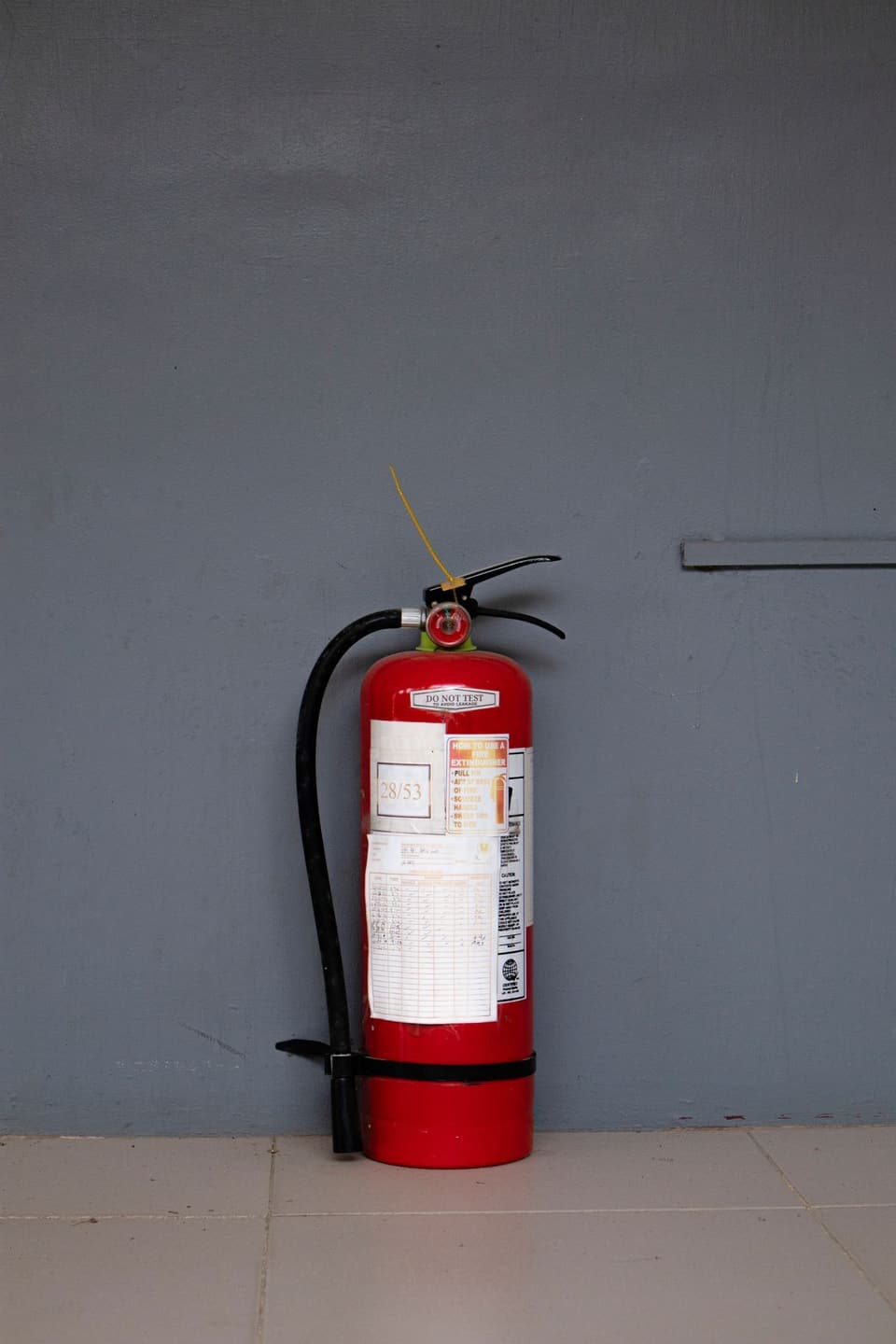
Almost every workplace, school and care home
Under the Regulatory Reform (Fire Safety) Order 2005, the Responsible Person must provide appropriate firefighting equipment where necessary, easy to reach and use, and maintained in efficient working order. Your fire risk assessment decides what is appropriate.
For almost every workplace, school, care home and the common parts of many HMOs, that means portable extinguishers, and often a fire blanket in kitchens. Our team supplies and services them.
In England and Wales
The duty is the same on both sides of the border. The law does not say how many extinguishers you need; your fire risk assessment does, and BS 5306-8 guides the type and position of each one.
Keep them in proportion
Extinguishers are for tackling small fires early and helping people escape, used by people who have been shown how. They are not a substitute for detection, alarms and a clear evacuation plan.
From survey to five-year planning
We match types to the hazards on each floor and remove equipment you do not need, which is as common as gaps.
Survey and siting
Types and positions for each floor, to BS 5306-8.
Supply and install
Extinguishers, stands, signs and fire blankets, commissioned on site.
Annual basic service
Every unit inspected by a competent technician to BS 5306-3.
Five and ten years
Extended service or replacement at five years; CO₂ overhaul or replacement at ten.
Labels and records
Each unit labelled and listed in a written service record.
Staff familiarisation
A short briefing on the types in your building and safe use.
What is due, done and recorded
Records check
Your fire risk assessment and last service labels show what you have and what is due.
Survey and quote
Types and positions for each floor, and a fixed price for the work.
Service or install
Our team does the work, then labels each unit.
Records
A service report listing every extinguisher, stored in the Vocus Fire Safety Portal.
Reminders
We book the next service and flag five and ten-year units well ahead.
A service record for every extinguisher
Each visit produces a written record of every extinguisher by location, type and manufacture date, the work done and any recommendations. With your monthly checks, it is the evidence your fire risk assessor, insurer or enforcing authority will ask to see.
- Every unit labelled with its service date
- Units condemned, moved or added, with reasons
- Five and ten-year work flagged in advance
- Stored in the Vocus Fire Safety Portal
The detail, when you need it
Extinguisher types and the fires they suit
Modern extinguishers have a red body with a coloured band or label showing the contents. Using the wrong type can make a fire worse.
| Type | Band | Suitable for | Do not use on |
|---|---|---|---|
| Water | Red | Class A: wood, paper, textiles | Electrical equipment, burning liquids, cooking oil |
| Foam | Cream | Class A and flammable liquids (Class B) | Cooking oil; check the label before using near electrics |
| Dry powder | Blue | Classes A, B and C (gases), and electrical fires | Enclosed spaces, where the powder cuts visibility and can be inhaled |
| CO₂ | Black | Electrical equipment and Class B liquids | Cooking oil; small rooms, where CO₂ displaces oxygen |
| Wet chemical | Yellow | Class F: cooking oils and fats, and Class A | Electrical equipment |
Water mist extinguishers are increasingly used as a single type covering several classes; check the manufacturer's rating before relying on one. Specialist powders are used for metal fires (Class D).
A fire blanket is the simplest way to smother a small pan fire or wrap someone whose clothing has caught fire. Mount it near the kitchen exit rather than over the hob, so you never reach across the fire.
Siting to BS 5306-8
Extinguishers should be on escape routes, near exits and close to specific hazards such as kitchens, plant rooms and server cupboards, mounted at a sensible height, clearly signed and never more than a short walk away. The standard sets maximum travel distances to an extinguisher and a minimum amount of Class A cover for each floor.
Servicing levels under BS 5306-3
Annual basic service: a competent technician checks condition, weight or pressure, seals, hose and horn, instructions and siting, and labels each unit with the date. Extended service at five years: water, foam and powder units are discharged, refilled and recharged. CO₂ overhaul at ten years: including a pressure test of the cylinder.
Between services, someone on site should check monthly that each extinguisher is in place, visible, undamaged and showing a pressure gauge in the green, and record it.
Why replacement often beats an extended service
An extended service means discharging the unit and paying for a new charge, parts and labour. For most standard units that costs as much as, or more than, a new extinguisher with a fresh five-year life. So at year five we usually recommend replacement, and budget for it. Our compliance contracts handle that spike: on the rolling contract the cost falls in the year it is due, and on the smoothed annual plan it is spread evenly across every year.
Staff familiarisation
People are far more likely to use an extinguisher safely if they have seen one up close. On request we give a short on-site briefing covering the types in your building, which fires each suits and when not to fight a fire at all. For fuller, hands-on training, see our fire safety training.
At a glance
- Who it's for
- Workplaces, schools, care homes, HMO common parts and any premises with firefighting equipment
- Standards
- BS 5306-3 (servicing) · BS 5306-8 (selection and siting)
- Frequency
- Annual basic service · extended service at 5 years · CO₂ overhaul at 10 years
- You receive
- Labelled units and a service record for every extinguisher
- Price
- Fixed quote before we visit
Speak to the team
Questions about your building or your duties? Talk them through with us before you commit to anything.
0330 133 4591Fire service experience, one accountable contract.
30+ years in Fire and Rescue
Our Managing Director, Paul Chamberlain, spent more than three decades in Fire and Rescue, from operational incident command to strategic leadership. That is the lens every assessment is written through.
Wales and England, done right
Fire safety law differs either side of the Severn. Every report and recommendation is written for the rules that actually apply to your building.
One accountable contract
Assessment, remediation and ongoing maintenance under one contract, with one point of contact. No gaps between contractors for you to manage.
Every record in one place
Reports, certificates and next-due dates for every site in the Vocus Fire Safety Portal, ready to show an inspector, insurer or auditor.
Fire extinguisher questions
Short answers to what people ask us most. Can't see yours? Call us on 0330 133 4591.
How often do fire extinguishers need servicing?
BS 5306-3 recommends a basic service by a competent person at least once a year. Water, foam and powder extinguishers also need an extended service, with discharge and refill, every five years, and CO₂ extinguishers an overhaul every ten years. You should also check them visually each month and record it.
Is it a legal requirement to have fire extinguishers?
The Fire Safety Order requires the Responsible Person to provide appropriate firefighting equipment where necessary and to maintain it, in both England and Wales. The law does not list how many extinguishers you need; your fire risk assessment decides that. In practice almost every non-domestic premises needs some.
Why replace an extinguisher instead of giving it an extended service?
An extended service means discharging the unit and paying for a new charge, parts and labour, which for most standard extinguishers costs about the same as a new one. A new unit also starts a fresh five-year life. We will always tell you which option is cheaper for your equipment.
Which extinguisher do I need for an office or electrical equipment?
Most offices need water or foam for general Class A risks, plus a CO₂ extinguisher near electrical equipment such as server cupboards and comms rooms. Kitchens with deep fat fryers need a wet chemical extinguisher. We confirm the right mix for each floor during the survey.
Can we do our own monthly checks?
Yes, and you should. A monthly check by someone on site confirms each extinguisher is in place, visible, undamaged, sealed and showing correct pressure. Record it in your logbook. The annual service must still be done by a competent technician.
How do you handle the year-five cost in a compliance contract?
On the annual rolling contract, replacement costs are paid in the year they fall, usually year five, so that year costs more. On the smoothed annual plan the same cost is spread evenly across every year, and over the full cycle it costs no more. See our compliance contracts page for how the two compare.
Services
Sectors
Further reading: Rolling contract vs smoothed annual plan · What is a PAS 79 fire risk assessment?
Get your extinguishers serviced
Tell us how many sites and extinguishers you have, and when they were last serviced. We will confirm what is due and a fixed price before we visit.